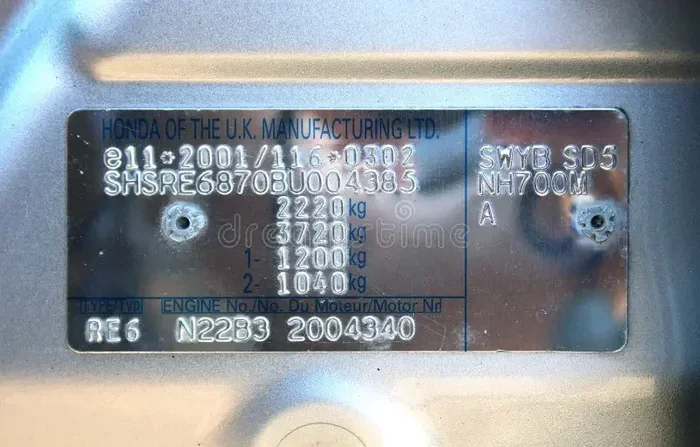
What Is the Check Digit of a Chassis Number Explained
The check digit of a chassis number is a single character that verifies the accuracy of a vehicle identification number. It acts as a built-in error-detection system, ensuring that the VIN has not been mistyped or tampered with. Understanding this digit helps you confirm a vehicle’s authenticity and avoid fraud.
Every vehicle on the road has a unique identifier. That identifier is the chassis number, often called the vehicle identification number or VIN. The VIN is a 17-character code that holds details about the manufacturer, model, and production year. But hidden within that code is a special character that many people overlook. That character is the check digit of a chassis number.
The check digit is the ninth character in the VIN. It is not a random letter or number. Instead, it is a calculated value that verifies the entire VIN is correct. Think of it as a mathematical fingerprint for your vehicle’s identity. If even one character in the VIN is wrong, the check digit will not match. This simple mechanism helps catch errors, fraud, and tampering.
In this article, we will break down everything you need to know about the check digit of a chassis number. You will learn how it is calculated, why it matters, and how you can verify it yourself. Whether you are buying a used car or just curious about VINs, this guide will give you clear, practical insights. Let us dive in.
Key Takeaways
- The check digit of a chassis number is the ninth character in a VIN and serves as a mathematical safeguard.
- It uses a weighted calculation and an alphabet-to-number conversion to detect errors and prevent fraud.
- The check digit helps reveal VIN tampering, cloning, and salvage title fraud.
- You can verify it yourself using online VIN decoder tools or a simple manual formula.
- ISO 3779 sets the global standard for VIN structure, including the check digit calculation.
- The check digit is not present in all older chassis numbers, but it is standard in modern 17-character VINs.
- Ignoring the check digit can lead to buying a vehicle with a hidden or altered history.
📑 Table of Contents
What Is the Check Digit of a Chassis Number?
The check digit of a chassis number is the ninth character in a standard vehicle identification number. It is the only position in the VIN that does not represent a specific vehicle attribute. Instead, it is a computed value that validates the entire sequence. The check digit uses a mathematical formula to ensure that the VIN has not been accidentally or intentionally altered. When you run a VIN check, the system recalculates the check digit and compares it to the one in the VIN. If they match, the VIN is likely valid. If they do not match, something is wrong. This system is a powerful tool for vehicle identification and fraud prevention.
The Role of the Check Digit in a VIN
The check digit sits right in the middle of the VIN. It acts as a bridge between the descriptor section and the identifier section. Its job is to confirm that the other 16 characters are correct. The formula behind the check digit was developed by the International Organization for Standardization. It is part of the ISO 3779 standard that governs VINs worldwide. The check digit can be a number from 0 to 9 or the letter X. The letter X represents the number 10 in the calculation. This allows the system to produce a single character that can detect most common errors.
When a VIN is entered into a database or a VIN decoder tool, the system automatically recalculates the check digit. If the recalculated value does not match the ninth character, the system flags the VIN as invalid. This simple check has saved buyers and law enforcement from countless fraudulent transactions. It is one of the most effective ways to verify a vehicle’s true identity.
How the Check Digit Fits into the VIN Structure
A VIN is divided into three main sections. Understanding these sections helps you see where the check digit lives and why it matters.
- World Manufacturer Identifier (WMI): The first three characters. They tell you the country of origin and the manufacturer. For example, 1G1 means a vehicle built by General Motors in the United States.
- Vehicle Descriptor Section (VDS): Positions 4 through 8. This section describes the vehicle’s attributes, such as the model, body type, engine type, and trim level.
- Check Digit: Position 9. The calculated character that validates the VIN.
- Vehicle Identifier Section (VIS): Positions 10 through 17. This includes the model year, assembly plant code, and the unique serial number for that specific vehicle.
The check digit is positioned exactly at the center of the VIN. This placement is not accidental. It allows the formula to check the characters both before and after it. If someone changes a character in the WMI or the VDS, the check digit will no longer match. The same applies to changes in the VIS. This makes the VIN extremely difficult to alter without being detected.
Quick Tips: Remembering the VIN Positions
- Positions 1-3: World Manufacturer Identifier (WMI)
- Positions 4-8: Vehicle Descriptor Section (VDS)
- Position 9: Check digit
- Position 10: Model year
- Position 11: Assembly plant
- Positions 12-17: Sequential serial number
The Math Behind the Check Digit Calculation
The check digit is not a guess. It is the result of a precise mathematical formula. The formula uses a weighted multiplication method that converts each character in the VIN into a number, multiplies it by a specific weight, and then sums the results. The final step is to divide the sum by 11 and use the remainder as the check digit. This process is defined in the international standard ISO 3779 and is used by every country that follows the VIN system.
The Weighted Multiplication Method
Each of the 16 other characters in the VIN (all except the check digit itself) is assigned a weight. The weights for positions 1 through 17 are: 8, 7, 6, 5, 4, 3, 2, 10, 0, 9, 8, 7, 6, 5, 4, 3, 2. Notice that position 9 has a weight of 0. This means the check digit does not factor into its own calculation. After multiplying each character by its weight, you add all the products together. Then, you divide the total by 11. The remainder is the check digit. If the remainder is 10, the check digit is the letter X.
This method is highly effective. It catches common errors like a single character being wrong or two characters being swapped. The number 11 is used because it is a prime number, which makes the formula more sensitive to changes in the VIN. The result is a robust error-detection system that has been tested and refined for decades.
The VIN Alphabet-to-Number Conversion Table
Before you can apply the weights, you must convert letters to numbers. The VIN uses a specific conversion table that skips the letters O, Q, and I to avoid confusion with the numbers 0, 9, and 1. Here is the full conversion:
- A = 1, B = 2, C = 3, D = 4, E = 5, F = 6, G = 7, H = 8
- J = 1, K = 2, L = 3, M = 4, N = 5
- P = 7, R = 9, S = 2, T = 3, U = 4, V = 5, W = 6, X = 7, Y = 8, Z = 9
The numbers 0 through 9 remain as they are. This conversion is essential for the calculation. If you use the wrong value for a letter, your final check digit will be wrong. Always double-check your conversion table before starting the math.
Step-by-Step Example Calculation
Let us walk through a real example. Suppose you have a VIN: 1G1BL52P7TR115520. We will calculate the check digit for this VIN, but note that the ninth character is 7 in this example. We will ignore the ninth character for the calculation and compute what the check digit should be.
First, list each character and its weight:
- Position 1: 1 (weight 8)
- Position 2: G (weight 7)
- Position 3: 1 (weight 6)
- Position 4: B (weight 5)
- Position 5: L (weight 4)
- Position 6: 5 (weight 3)
- Position 7: 2 (weight 2)
- Position 8: P (weight 10)
- Position 9: [skip]
- Position 10: 7 (weight 9)
- Position 11: R (weight 8)
- Position 12: 1 (weight 7)
- Position 13: 1 (weight 6)
- Position 14: 5 (weight 5)
- Position 15: 5 (weight 4)
- Position 16: 2 (weight 3)
- Position 17: 0 (weight 2)
Now convert the letters: G=7, B=2, L=3, P=7, R=9.
Multiply each character by its weight:
- 1 x 8 = 8
- 7 x 7 = 49
- 1 x 6 = 6
- 2 x 5 = 10
- 3 x 4 = 12
- 5 x 3 = 15
- 2 x 2 = 4
- 7 x 10 = 70
- 7 x 9 = 63
- 9 x 8 = 72
- 1 x 7 = 7
- 1 x 6 = 6
- 5 x 5 = 25
- 5 x 4 = 20
- 2 x 3 = 6
- 0 x 2 = 0
Add all these products: 8 + 49 + 6 + 10 + 12 + 15 + 4 + 70 + 63 + 72 + 7 + 6 + 25 + 20 + 6 + 0 = 373.
Divide 373 by 11: 373 / 11 = 33 with a remainder of 10. A remainder of 10 means the check digit is the letter X. In this example, the ninth character is 7, not X. So this VIN would be invalid. This simple example shows how the check digit catches errors and protects the integrity of the VIN.
Common Mistakes in the Calculation
- Forgetting to skip the ninth character during the sum.
- Using the wrong weight for a position. The weights are fixed and must be followed exactly.
- Converting letters incorrectly. Remember that O, Q, and I are never used in a VIN.
- Forgetting that a remainder of 10 becomes the letter X.
- Using the check digit itself in the calculation, which always gives a remainder of 0 and defeats the purpose.
Why the Check Digit Matters for Vehicle Owners
The check digit is not just a technical detail. It has real-world consequences for anyone who buys, sells, or owns a vehicle. Understanding its importance helps you protect yourself from fraud and make informed decisions.
Detecting VIN Tampering and Fraud
VIN tampering is a serious problem. Scammers may alter a VIN to hide a stolen vehicle or a salvage title. They might change a few characters to make the VIN look valid on the surface. However, the check digit acts as a safeguard. If someone changes even one character in the VIN, the check digit will no longer match the recalculated value. A simple VIN check will immediately flag the discrepancy. This makes the check digit a powerful tool against fraud.
Law enforcement and title offices rely on the check digit to verify vehicle identity. When you perform a VIN check before buying a car, the system is checking this digit to ensure the VIN is authentic. If the check digit fails, the vehicle may have a hidden history. It could be a stolen car, a flood-damaged vehicle, or a car with a rolled-back odometer. Always verify the check digit before you complete a purchase.
Ensuring Accurate Vehicle History Reports
Vehicle history reports from services like Carfax or AutoCheck depend on accurate VINs. The check digit ensures that the VIN entered into the database is correct. If the check digit is wrong, the system may not find the vehicle’s history. You might get a “no records found” message, even though the vehicle has a full history. This can be frustrating and confusing. By verifying the check digit, you ensure that your VIN is valid and that the history report will return accurate information.
A correct check digit gives you confidence that the vehicle you are researching is the real one. It also ensures that any liens, accidents, or service records are properly linked to that specific chassis. This level of accuracy is essential when you are spending thousands of dollars on a used vehicle.
Expert Insights: Why Dealerships Rely on the Check Digit
Dealerships and lenders run VIN checks on every vehicle they handle. The check digit is one of the first things they validate. If the check digit does not match, they will not proceed with the sale or financing. This protects them from legal liability and financial loss. It also protects the buyer. A dealership that skips the check digit verification is taking a risk. As a consumer, you should expect any reputable dealer to confirm the check digit before you sign paperwork. If they do not, that is a red flag.
Key Takeaways: Why the Check Digit Matters
- The check digit is the primary defense against VIN tampering and fraud.
- A mismatched check digit can reveal a stolen or salvage vehicle.
- Accurate check digits ensure that vehicle history reports return correct results.
- Reputable dealerships and lenders always verify the check digit.
- Ignoring the check digit can lead to costly mistakes and legal issues.
How to Verify the Check Digit Yourself
You do not need to be a mathematician to verify the check digit. There are simple tools and methods you can use right from your computer or phone. Verifying the check digit takes only a few minutes and can save you from a bad purchase.
Using Online VIN Decoder Tools
The easiest way to verify the check digit is to use a free online VIN decoder. Simply enter the full 17-character VIN, and the tool will display whether the check digit is valid. Many of these tools also pull the vehicle’s details from the VIN, such as the manufacturer, model, and year. They are a quick and easy way to check a VIN. However, not all online tools are equally reliable. Stick to well-known services or the official National Insurance Crime Bureau (NICB) VIN check. A reliable VIN decoder will give you peace of mind and accurate results.
When using an online tool, make sure you enter the VIN exactly as it appears on the dashboard or the driver’s side door jamb. Even a single extra space or missing character can cause the check digit to fail. If the tool says the VIN is invalid, do not ignore the warning. Double-check the VIN and run the check again. If it still fails, walk away from the vehicle.
Manual Calculation Tips
If you want to verify the check digit manually, follow these steps. First, write down the VIN and assign weights to each position. Second, convert all letters to numbers using the conversion table. Third, multiply each character by its weight. Fourth, sum all the products. Fifth, divide the sum by 11 and find the remainder. Sixth, compare the remainder to the ninth character of the VIN. If the remainder is 10, the check digit should be X. If it matches, the VIN is valid. If it does not match, there is an error.
This process takes only a few minutes. It is a great way to double-check a VIN before a purchase. You can also use a spreadsheet to automate the calculation. Just list each character, its weight, and its converted value, then use the SUM and MOD functions to find the remainder.
Quick Tips for Manual Verification
- Always use the official conversion table. Do not guess the values for letters.
- Double-check your arithmetic. A single addition error will give you the wrong check digit.
- Remember that the letter X is the only letter used as a check digit.
- If you get a remainder of 0, the check digit is 0. If you get a remainder of 10, the check digit is X.
- Use a VIN decoder tool to confirm your manual result. This catches any mistakes you might have made.
Key Takeaways: Verifying the Check Digit
- The check digit is the ninth character in a VIN.
- It is calculated using a weighted sum of the other 16 characters.
- The formula divides the sum by 11 and uses the remainder.
- A remainder of 10 is represented by the letter X.
- Online VIN decoders can verify the check digit instantly.
- A mismatch indicates an invalid or tampered VIN.
Global Standards and the Check Digit
The check digit is not just a North American invention. It is part of a global system that standardizes vehicle identification across countries. Understanding these standards helps you see why the check digit is so important and how it fits into the bigger picture of vehicle regulation.
ISO 3779 and the International VIN System
The check digit is part of the international standard ISO 3779. This standard defines the structure of VINs for all road vehicles. It was developed to create a universal system for vehicle identification. Before ISO 3779, different countries used different chassis number formats. This caused confusion and made it hard to track vehicles across borders. The ISO standard introduced the 17-character VIN and the check digit. Today, most countries follow this standard, including the United States, Canada, and all European Union member states. The check digit is a key part of this global framework. It ensures that a VIN from one country can be verified anywhere in the world.
The ISO 3779 standard also covers other aspects of the VIN, such as the WMI and VDS sections. It ensures that every vehicle has a unique identifier that can be traced back to its manufacturer. The check digit adds an extra layer of security to this system. Without it, the VIN would be just a string of characters with no built-in way to verify its accuracy.
Differences Between North American and Global VIN Formats
While the ISO standard is global, there are some regional differences. In North America, the VIN includes a check digit in the ninth position. This is required by the National Highway Traffic Safety Administration (NHTSA). In Europe, the VIN follows the same ISO 3779 structure, but some older vehicles may not have a check digit. The European system also allows for a 16-character VIN in some cases. However, modern European vehicles use the full 17-character VIN with a check digit. In Asia, countries like Japan and South Korea also follow the ISO standard. The check digit is a common thread across all these regions. It is the one character that ties the global system together.
| VIN Position | Section | Meaning |
|---|---|---|
| 1-3 | WMI | World Manufacturer Identifier (country, manufacturer) |
| 4-8 | VDS | Vehicle Descriptor Section (model, body, engine) |
| 9 | Check Digit | Validation character (calculated) |
| 10 | VIS | Model year |
| 11 | VIS | Assembly plant |
| 12-17 | VIS | Sequential serial number |
Quick Tips: Understanding Regional Differences
- North American VINs always include a check digit in position 9.
- Older European VINs may be 16 characters and lack a check digit.
- Modern vehicles worldwide use the 17-character VIN with a check digit.
- Always verify the check digit regardless of the vehicle’s origin.
Conclusion: The Check Digit Protects Your Vehicle’s Identity
The check digit of a chassis number is a small but mighty component of your vehicle’s identity. It is the mathematical guardian that ensures your VIN is accurate and trustworthy. By understanding how it works, you can protect yourself from fraud and make smarter decisions when buying or selling a vehicle. Whether you use an online tool or calculate it by hand, the check digit gives you a reliable way to verify a VIN.
Next time you see a chassis number, remember the ninth character. That single digit holds the power to confirm authenticity and safeguard your investment. Take a moment to check it. It could save you from a costly mistake. The check digit of a chassis number is your first line of defense in the world of vehicle identification. Use it wisely, and always verify before you buy.
Frequently Asked Questions
What is the check digit of a chassis number?
The check digit of a chassis number is the ninth character in a 17-character vehicle identification number (VIN). It is a calculated value that verifies the accuracy of the entire VIN and helps detect errors or tampering.
How is the check digit calculated?
The check digit is calculated using a weighted multiplication method. Each of the other 16 VIN characters is converted to a number, multiplied by a specific weight, and then summed. The total is divided by 11, and the remainder becomes the check digit. A remainder of 10 is represented by the letter X.
Can a VIN be valid without a check digit?
Modern 17-character VINs always include a check digit in the ninth position. However, some older chassis numbers or non-road vehicles may not have a check digit. The check digit is a standard part of the ISO 3779 VIN format used worldwide today.
Why is the check digit important when buying a used car?
The check digit helps reveal VIN tampering, cloning, and fraud. If the check digit does not match, the VIN may have been altered to hide a stolen or salvage vehicle. Verifying the check digit is a quick way to protect yourself from buying a vehicle with a hidden history.
What happens if the check digit is wrong?
A wrong check digit means the VIN is invalid. The vehicle may have a tampered VIN, which can cause problems with registration, insurance, and resale. A VIN check will flag the mismatch, and you should avoid purchasing the vehicle until the issue is resolved.
How can I verify the check digit myself?
You can verify the check digit using a free online VIN decoder tool or by performing the manual calculation. Online tools are fast and easy. If you prefer to calculate it yourself, follow the weighted multiplication method using the official ISO 3779 conversion table and weights.