When Should Drivers Avoid Using Cruise Control on Highways
Knowing when to turn off cruise control can save your life on the highway. Many drivers rely too heavily on this feature without understanding the risks it creates in certain conditions. This guide covers the critical moments when you should avoid using cruise control, from wet roads to heavy traffic and beyond. You will learn practical safety tips that every driver needs to know.
Cruise control feels like one of the greatest inventions for long highway drives. You set a speed, take your foot off the pedal, and enjoy the ride. It is relaxing. It is convenient. But here is the thing most drivers forget — cruise control is not always safe. There are specific moments when keeping it on can put you and everyone around you at risk. Understanding when should drivers avoid using cruise control is one of the most important safety lessons on the road today.
Many people think cruise control only turns on when you want it to. The truth is, modern vehicles make it very easy to activate it by accident. And once it is on, it does not think the way you do. It does not see the rain starting. It does not notice the traffic slowing down ahead. It simply holds the speed you set. That lack of awareness is exactly why knowing the right and wrong times to use it matters so much. This article breaks down every situation where you should seriously reconsider using cruise control on highways.
Key Takeaways
- Avoid cruise control on wet or icy roads: Reduced tire traction makes sudden braking dangerous when your car is set to a fixed speed.
- Turn it off in heavy traffic: Stop-and-go situations require constant speed adjustments that cruise control cannot handle safely.
- Fatigue is a major risk factor: Relying on cruise control when drowsy reduces your alertness and reaction time significantly.
- Steep hills demand manual control: Cruise control can cause speed surges on downhills and sluggish responses on uphills.
- Poor visibility demands full attention: Fog, heavy rain, and dust storms require you to be ready to adjust speed instantly.
- Overuse dulls your driving skills: Constant reliance on cruise control can reduce your awareness and muscle memory for manual driving.
- Use cruise control wisely: It is a helpful tool on long, dry, open highways with steady traffic and good visibility.
📑 Table of Contents
- What Is Cruise Control and Why Do People Love It?
- When Should Drivers Avoid Using Cruise Control on Highways
- The Hidden Dangers of Over-Relying on Cruise Control
- How Cruise Control Affects Your Driving Skills Over Time
- When Is It Safe to Use Cruise Control?
- Expert Tips for Smart Cruise Control Use
- Common Mistakes Drivers Make with Cruise Control
- Final Thoughts on Cruise Control Safety
What Is Cruise Control and Why Do People Love It?
Before we dive into the dangers, let us quickly understand what cruise control actually does. Cruise control is a system that keeps your vehicle moving at a steady speed without you pressing the gas pedal. You set your desired speed, and the car maintains it automatically. Simple as that.
People love cruise control for good reasons. On long road trips, it reduces leg fatigue. It helps maintain a consistent speed limit without constantly checking the speedometer. It also promotes fuel efficiency on flat, open roads. For many drivers, cruise control is a daily comfort they would not want to give up. But comfort should never come at the cost of safety.
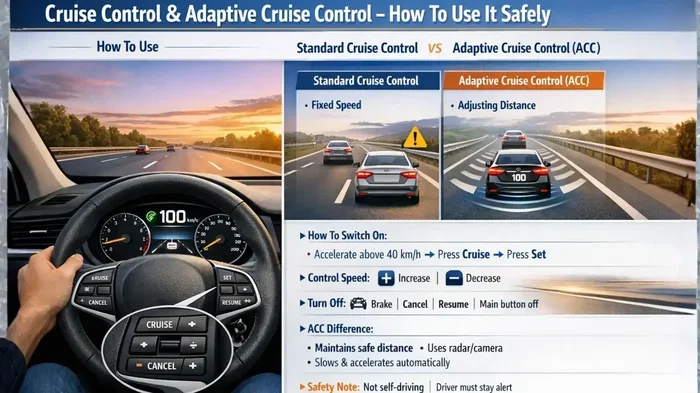
Modern vehicles now offer adaptive cruise control, which uses sensors to keep a safe distance from the car ahead. This is a step forward, but it still has limitations. Adaptive systems can struggle in heavy rain, sudden stops, and complex driving environments. So even with advanced features, knowing when to disable cruise control remains essential.
When Should Drivers Avoid Using Cruise Control on Highways
This is the core of our discussion. There are several clear situations where drivers should avoid using cruise control. Each one presents unique risks that demand your full attention and manual control of the vehicle. Let us walk through them one by one.
Wet and Icy Road Conditions
This is the number one reason to turn off cruise control. When roads are wet from rain or covered in ice and snow, your tires lose traction. If your car starts to hydroplane or slide on ice and cruise control is active, the system will keep trying to maintain speed. This can make the situation much worse. Instead of letting you slow down naturally, cruise control may actually increase engine power to maintain the set speed, which can cause a complete loss of control.
Think about it this way. When you feel your car sliding, your natural instinct is to ease off the gas. With cruise control on, that instinct is overridden. The system fights your input. According to traffic safety experts, hundreds of accidents each year are linked to cruise control use on slippery surfaces. The simple fix is to turn it off whenever the road looks even slightly wet or cold.
Here is a quick tip. If the road surface looks shiny or glossy, that is a sign of potential ice or standing water. Turn off cruise control immediately. Reduce your speed gently and increase your following distance. These small actions can prevent a serious collision.
Heavy Traffic and Stop-and-Go Situations
Highways are not always open and free-flowing. Sometimes you hit construction zones, merge into dense traffic, or deal with slow-moving congestion. In these situations, cruise control becomes more of a hazard than a help. You need to constantly adjust your speed, brake, and accelerate based on the vehicles around you. Cruise control simply cannot do that as safely as you can.
Even with adaptive cruise control, stop-and-go traffic can be tricky. These systems are designed for moderate speeds and gradual changes. When traffic comes to a complete stop and then starts again, the system may lag. You could find yourself too close to the car in front or jerking forward unexpectedly. The best practice is to disable cruise control whenever traffic speed drops below about 25 miles per hour and starts fluctuating frequently.
Another issue with cruise control in traffic is distraction. When your foot does not need to work, your mind tends to wander. In heavy traffic, that split-second of inattention can be the difference between a safe drive and a fender-bender. Keep your foot near the pedals and your eyes on the traffic around you at all times.
Fatigue and Drowsiness Behind the Wheel
You might think cruise control helps when you are tired because it reduces the physical effort of driving. But this is actually a dangerous misconception. When you are drowsy, your reaction time slows down dramatically. Cruise control does not react for you. It only controls your speed. You still need to steer, monitor traffic, and be ready to brake at any moment.
If you are fighting sleepiness on a long highway drive, cruise control can lull you into an even deeper sense of relaxation. Some drivers report feeling almost hypnotized by the steady movement of the car. This is exactly the wrong state to be in when you need sharp reflexes. Studies from the AAA Foundation for Traffic Safety show that drowsy driving causes thousands of crashes every year, and cruise control use can contribute to a false sense of alertness.
What should you do instead? Pull over at a rest stop or a safe parking area. Take a break. Get some fresh air, stretch your legs, or grab a coffee. If you are too tired to drive safely, no convenience feature on your dashboard is going to change that. The best rule is simple — if you feel sleepy, stop driving.
Steep Hills and Mountain Roads
Highway driving is not always flat. Many routes include steep inclines and long downhills, especially in mountainous regions. Cruise control handles these situations poorly. On steep uphill grades, the system may struggle to maintain speed and cause the engine to rev excessively. On downhills, cruise control may allow your vehicle to pick up speed faster than you would with manual control.
On a long downhill stretch, gravity pulls your car faster and faster. If cruise control is active, it keeps applying throttle to maintain the set speed. This means you could end up going well over the posted speed limit without even realizing it. By the time you notice, it may be too late to safely slow down. Experienced drivers know that the safest approach on steep hills is to use a lower gear and control speed manually.
Additionally, mountain roads often have sharp curves, unexpected drop-offs, and changing weather. These all demand constant speed adjustments that cruise control cannot provide. Turn it off before entering any hilly or winding highway section and take full control of your vehicle.
Poor Visibility Conditions
Fog, heavy rain, sleet, dust storms, and even bright glare at sunrise or sunset all reduce your ability to see the road ahead. In these conditions, you need to be able to slow down instantly if you spot a hazard. Cruise control works against this instinct because it maintains speed regardless of what is happening around you.
Imagine driving through thick fog on a highway. Visibility drops to just a few car lengths. A vehicle ahead of you brakes suddenly. If your cruise control is set for 70 miles per hour, you are moving far too fast for the conditions. Your braking distance increases dramatically, and the cruise control system does not know to slow down. This scenario is terrifyingly common and entirely preventable.
The rule here is straightforward. If you cannot see clearly for at least a quarter mile ahead, turn off cruise control. Reduce your speed to match the visibility. Keep both hands on the wheel and your full attention on the road. No destination is worth arriving at unsafely.
The Hidden Dangers of Over-Relying on Cruise Control
Beyond the obvious situations, there are several hidden dangers that many drivers overlook. These subtle risks build up over time and can lead to serious problems on the highway.
One hidden danger is tailgating. When cruise control keeps you at a steady speed, it is easy to get too close to the vehicle ahead. Without the natural rhythm of lifting off the gas and pressing the brake, drivers tend to maintain an unsafe following distance. This leaves no room for error if the car in front stops suddenly.
Another concern is speed variance. Cruise control works best on flat, straight roads with consistent conditions. But highways are dynamic. Curves, traffic patterns, and road surface changes all require speed adjustments. When drivers rely too heavily on cruise control, they become less aware of these changes and may be driving at an unsafe speed without realizing it.
There is also the issue of cruise control malfunction. Like any electronic system, cruise control can fail. A sensor error, a software glitch, or a blown fuse can cause the system to behave unpredictably. When this happens at highway speeds, the results can be catastrophic. Keeping your hands on the wheel and your foot near the pedals at all times gives you the ability to take over instantly if something goes wrong.
How Cruise Control Affects Your Driving Skills Over Time
This might sound surprising, but using cruise control too often can actually make you a worse driver over time. When you let a machine control your speed for hours at a stretch, your muscle memory for manual driving weakens. You become less tuned in to your speed, less aware of road conditions, and less responsive to sudden changes.
Think about it like riding an escalator versus walking up stairs. The escalator does all the work, so your leg muscles stay relaxed. But if you suddenly need to walk up a flight of stairs, you feel sluggish and unprepared. Cruise control works the same way for your driving instincts. When you need to take over quickly, you may feel slow and out of practice.
Driving experts recommend using cruise control in moderation. Use it on long, straight, dry highways where conditions are predictable. But turn it off frequently enough that your driving skills stay sharp. A good habit is to manually drive for at least a few minutes every hour, even on the longest road trips. This keeps your reflexes active and your awareness high.
When Is It Safe to Use Cruise Control?
Now that we have covered all the situations to avoid, let us talk about when cruise control is actually a good idea. The good news is that cruise control is perfectly safe — even beneficial — in the right conditions.
Use cruise control when:
- The highway is dry and well-maintained
- Traffic is flowing steadily at a consistent speed
- Visibility is clear and conditions are predictable
- You are on flat or gently rolling terrain
- You feel alert and fully focused on the road
- You are taking a long trip and want to reduce fatigue in your legs
In these conditions, cruise control can actually improve your driving experience. It reduces leg strain, helps you maintain the speed limit consistently, and allows you to focus more on steering and scanning the road ahead. The key is matching the tool to the right situation.
If your vehicle has adaptive cruise control, you gain an extra layer of safety even in moderate traffic. These systems use radar or cameras to adjust your speed based on the car ahead. But remember — adaptive cruise control is still a driver assistance feature, not a replacement for active driving. You must always stay engaged and ready to take full control.
Expert Tips for Smart Cruise Control Use
Here are some practical tips from experienced driving instructors and safety professionals to help you use cruise control wisely and safely.
- Always keep your hands on the wheel. Even with cruise control on, your hands should never leave the steering wheel for more than a moment. This ensures you are ready to steer or brake instantly.
- Set a safe following distance. Leave plenty of room between you and the car ahead. This gives you more time to react if cruise control does not adjust fast enough for sudden traffic changes.
- Check your speed frequently. Do not assume cruise control is keeping you at the right speed. Periodically glance at the speedometer to confirm you are within the legal limit and safe for conditions.
- Know how to cancel cruise control quickly. Practice tapping the brake pedal or pressing the cancel button so you can disable it instantly in an emergency. This should become second nature.
- Do not use cruise control at night in unfamiliar areas. Reduced visibility and unknown road conditions make cruise control riskier after dark, especially on roads you have not driven before.
- Keep your vehicle well-maintained. Ensure your tires have proper tread depth and air pressure. Worn tires reduce traction and make cruise control use more dangerous in any condition, not just bad weather.
- Use the highest level of cruise control your vehicle offers. If your car has adaptive cruise control, use it. It provides more safety features than standard cruise control, but still requires your full attention.
These tips may seem simple, but they can make a significant difference in your safety on every highway drive. The goal is not to avoid cruise control entirely — it is to use it intelligently and know exactly when to turn it off.
Common Mistakes Drivers Make with Cruise Control
Even experienced drivers make mistakes when it comes to cruise control. Here are the most common ones and how to avoid them.
- Leaving cruise control on when conditions change. Weather and traffic can shift quickly. Always reassess whether cruise control is appropriate every few minutes.
- Setting cruise control too close to the speed limit. Just because the limit is 70 mph does not mean 70 mph is safe in rain or fog. Always adjust your speed to match conditions, not just the posted limit.
- Ignoring cruise control warning lights. If your dashboard shows a cruise control warning or fault indicator, do not ignore it. Have the system checked before your next trip.
- Assuming adaptive cruise control handles everything. Adaptive systems still have blind spots and limitations. They can struggle with sharp curves, sudden stops, and poor weather. Never treat them as a fully autonomous driving system.
- Using cruise control after drinking. This is a dangerous myth. Cruise control does not compensate for impaired judgment or slowed reaction time. Never use any driving aid if you have been drinking.
Avoiding these mistakes keeps you safer and helps you get the most benefit from your cruise control system without putting yourself at unnecessary risk.
Final Thoughts on Cruise Control Safety
Cruise control is a wonderful tool when used correctly. It makes long highway drives more comfortable and helps maintain a steady, legal speed. But it is not a substitute for active, attentive driving. The moments when you should avoid using cruise control are not rare exceptions — they are the situations where safety matters most. Wet roads, heavy traffic, fatigue, steep hills, and poor visibility all demand your full engagement behind the wheel.
When should drivers avoid using cruise control on highways? The answer is clear — whenever conditions demand more from you than a fixed speed can provide. Trust your instincts. If something feels off, turn the system off. If the weather changes, turn it off. If you feel tired, turn it off. Your safety and the safety of others on the road always come first.
Take a few minutes to review your vehicle’s cruise control manual. Understand exactly how your system works and what its limitations are. Make it a habit to evaluate road conditions before you activate cruise control. These small steps can lead to safer, more confident highway driving for years to come.
Drive smart. Stay alert. Use cruise control as a helpful assistant, not a replacement for your judgment. The highway is shared by many different types of drivers, and the best way to stay safe is to stay fully in control of your vehicle at all times.
Frequently Asked Questions
Can you use cruise control in the rain?
You should avoid using cruise control in the rain. Wet roads reduce tire traction, and if your car begins to hydroplane, cruise control can cause the vehicle to accelerate instead of slowing down. Turn it off whenever road surfaces are wet or slippery to maintain full control of your vehicle.
Does adaptive cruise control work in fog?
Adaptive cruise control can struggle in fog because the sensors that detect the vehicle ahead may become less accurate in heavy mist. Even with this system, you should reduce your speed and stay alert. Never rely solely on adaptive cruise control in low-visibility conditions.
Is it illegal to use cruise control on highways?
No, using cruise control on highways is not illegal in most places. However, drivers are still responsible for maintaining safe speeds and staying in control at all times. If cruise control causes you to drive unsafely, you could be held liable for an accident.
Why does cruise control make me more tired?
Cruise control removes the need to constantly adjust your speed, which can make your mind and body more relaxed. This relaxation can turn into drowsiness over time, especially on long, monotonous highway stretches. To combat this, take regular breaks and avoid using cruise control when you are already feeling sleepy.
Should you use cruise control on mountain highways?
You should generally avoid cruise control on mountain highways. Steep inclines and descents require constant speed adjustments that cruise control cannot handle well. On downhills especially, the system may allow your vehicle to gain dangerous speed. Use manual control and lower gears on mountain roads.
How do you turn off cruise control quickly in an emergency?
The fastest way to turn off cruise control in an emergency is to press the brake pedal firmly. This instantly disables the system and gives you full manual control. You can also press the cancel button on the steering wheel or dash. Practice locating these controls so you can act without thinking in a critical moment.
=== CONCLUSION ===
Knowing when should drivers avoid using cruise control on highways is one of the most valuable safety skills any driver can develop. The moments we have covered — wet roads, heavy traffic, fatigue, steep hills, and poor visibility — represent the situations where cruise control shifts from being a helpful feature to a genuine hazard. Every driver should take a moment to evaluate conditions before hitting that cruise control button.
Stay aware. Stay alert. Use cruise control as a tool to enhance your comfort, not to replace your attention. Safe driving is a choice you make every time you get behind the wheel, and smart cruise control use is a big part of that choice.