How Bugatti Achieves Extreme Speed and Breaks Records
Bugatti achieves extreme speed through a combination of a massive quad-turbo W16 engine, advanced aerodynamics, and a lightweight carbon fiber chassis. The company has shattered speed records multiple times, proving that French hypercar engineering is in a league of its own. From the Chiron to the Bolide, every Bugatti model pushes the boundaries of what a production car can do.
Bugatti is not just a car brand. It is a statement of what happens when engineering meets obsession. For decades, this French luxury automaker has built some of the fastest cars ever made. People around the world watch in awe as Bugatti vehicles shatter speed records one after another. But how does Bugatti actually achieve extreme speed? What is happening under the hood and beneath the bodywork that allows these machines to go so fast?
The answer lies in a perfect blend of raw power, smart design, and relentless testing. Every single component of a Bugatti is engineered with one goal in mind: going faster. From the engine to the tires, nothing is left to chance. In this article, we will break down exactly how Bugatti achieves extreme speed and why it keeps breaking records year after year.
Whether you are a car enthusiast or just curious about the science behind speed, this guide covers everything. We will look at the engine, the aerodynamics, the materials, and the technology that make Bugatti the king of hypercars. So buckle up and let us dive into the world of extreme speed.
Key Takeaways
- Quad-Turbo W16 Engine: Bugatti’s 8.0-liter W16 engine with four turbochargers produces over 1,500 horsepower, making it one of the most powerful engines ever built.
- Advanced Aerodynamics: Active aerodynamics and a low drag coefficient keep Bugatti stable and fast at extreme velocities.
- Lightweight Construction: Carbon fiber monocoque chassis and lightweight materials reduce weight while maintaining incredible strength.
- Specialized Transmission: A seven-speed dual-clutch gearbox shifts gears in milliseconds, ensuring power reaches the wheels without delay.
- Record-Breaking Speed: Bugatti has repeatedly broken speed records, with models like the Chiron Super Sport 300+ hitting over 300 mph.
- Custom Build Process: Each Bugatti is hand-built to order, and if you are curious about how long do custom car orders take, expect a wait of several years.
📑 Table of Contents
- The Heart of Speed: The Quad-Turbo W16 Engine
- Aerodynamics: Shaping the Air Around the Car
- Lightweight Materials and Strong Construction
- The Transmission and Drivetrain: Delivering Power to the Road
- Braking and Safety at Extreme Speeds
- Breaking Records: Bugatti’s Speed Milestones
- Owning a Bugatti: What It Takes
- Conclusion
The Heart of Speed: The Quad-Turbo W16 Engine
What Makes the W16 Engine So Special
At the center of every Bugatti is the legendary W16 engine. This is not a regular engine. It is a massive 8.0-liter powerhouse with four turbochargers bolted to it. The name W16 comes from the shape of the engine. It has four rows of four cylinders arranged in a W pattern. This design allows Bugatti to fit 16 cylinders into a compact space while still delivering enormous power.
The result is staggering. The latest Bugatti models produce over 1,500 horsepower and more than 1,100 pound-feet of torque. To put that in perspective, most family sedans produce between 150 and 300 horsepower. A Bugatti has five times that amount. This is what allows the car to launch from zero to 60 mph in under 2.5 seconds.
How the Turbochargers Work Together
Bugatti uses four turbochargers instead of two or one. Why? Because a single turbocharger struggles to deliver power at both low and high speeds. This is called turbo lag. By using four smaller turbochargers, Bugatti eliminates this problem almost completely. The turbos spool up quickly and deliver a smooth, relentless surge of power across the entire rev range.
Each turbocharger is precision-matched to the engine. They are not off-the-shelf parts. Bugatti engineers design and test every turbo to work perfectly with the W16 configuration. This level of customization is one reason why Bugatti can extract so much performance from a single engine.
Fuel Consumption at Extreme Speeds
All that power comes at a cost. A Bugatti burns through fuel incredibly fast, especially at high speeds. If you have ever wondered how long does a full tank of gas last at top speed, the answer is not long. At maximum velocity, a Bugatti can use up its entire fuel tank in under 15 minutes. This is why Bugatti engineers also focus heavily on fuel efficiency during normal driving, using advanced fuel injection systems and cylinder deactivation technology.
Aerodynamics: Shaping the Air Around the Car
Why Aerodynamics Matter for Speed
Power alone does not make a car fast. You also need to manage the air around it. At speeds above 200 mph, air resistance becomes the biggest enemy of speed. This force is called drag. The more drag a car has, the harder the engine has to work. Bugatti spends millions of dollars perfecting the shape of every car to minimize drag.
The body of a Bugatti is designed in a wind tunnel. Engineers test hundreds of shapes and angles to find the perfect balance between downforce and drag. Downforce pushes the car down onto the road, keeping it stable at high speeds. But too much downforce creates more drag, which slows the car down. Finding the sweet spot is the key.
Active Aerodynamics in Action
Modern Bugatti models use active aerodynamics. This means parts of the car move automatically based on driving conditions. For example, the rear spoiler on a Bugatti Chiron adjusts its angle depending on speed. At lower speeds, it lies flat to reduce drag. At top speed, it tilts upward to generate maximum downforce.
The front grille also opens and closes to manage airflow to the engine and brakes. When the car needs cooling, the grille opens. When the car is at top speed, the grille closes to reduce drag. This smart system gives Bugatti a major advantage over competitors who use fixed aerodynamic parts.
For comparison, consider how at what speed does the prius switch to gas. The Prius uses a simple engine switch, but Bugatti uses complex active systems that adjust dozens of times per second. The difference in complexity shows just how far hypercar technology has come.
The Role of the Drag Coefficient
Every car has a drag coefficient, often written as Cd. This number measures how aerodynamic a shape is. A lower number means less drag. Most standard cars have a Cd between 0.25 and 0.35. Bugatti has managed to bring some of its models below 0.36, which is impressive given their wide, muscular design. The Bolide, Bugatti’s track-focused hypercar, has a Cd of just 0.21. That is incredibly low for a car that is over 15 feet long.
Lightweight Materials and Strong Construction
The Carbon Fiber Monocoque Chassis
Speed is not just about power and aerodynamics. Weight matters too. A lighter car accelerates faster, brakes shorter, and handles better. Bugatti builds its cars around a carbon fiber monocoque chassis. This is a single-piece structure that serves as both the body and the frame. It is incredibly strong and remarkably light.
To give you an idea of size, you might ask, how long is a car in feet for a Bugatti? The Chiron is about 17.9 feet long, yet the entire chassis weighs less than 250 pounds. That is lighter than many car engines. This combination of strength and low weight is what allows Bugatti to handle extreme forces at high speeds without flexing or breaking.
Other Lightweight Components
Bugatti does not stop at the chassis. Nearly every part of the car is designed to be as light as possible. The body panels are made from carbon fiber. The wheels are forged from lightweight alloys. Even the seats are stripped down to reduce weight. Every gram counts when you are chasing world records.
The interior of a Bugatti is surprisingly minimal compared to a luxury sedan. There are no heavy sound systems or bulky entertainment screens. Instead, the focus is on weight reduction and driver control. This might seem extreme, but it is what allows Bugatti to achieve speeds that other cars simply cannot reach.
The Transmission and Drivetrain: Delivering Power to the Road
Seven-Speed Dual-Clutch Gearbox
All that horsepower would be useless if the gearbox could not handle it. Bugatti uses a seven-speed dual-clutch transmission. This type of gearbox uses two clutches instead of one. One clutch handles odd gears, and the other handles even gears. When you shift up, the next gear is already pre-selected. The result is gear changes that happen in just milliseconds.
You barely even feel the shifts. The power delivery is seamless, which is critical at extreme speeds. A traditional automatic transmission would cause a momentary loss of power during each shift. The dual-clutch system eliminates this problem entirely.
All-Wheel Drive for Traction
With over 1,500 horsepower, traction is a major challenge. If all that power goes to spinning tires, the car will not go fast. Bugatti solves this with an all-wheel-drive system. Power is sent to all four wheels, which maximizes grip and stability.
The system is intelligent. It can send more power to the front or rear wheels depending on driving conditions. During acceleration, more power goes to the rear wheels. In corners, more power goes to the front wheels to help with steering response. This dynamic distribution is a key reason why Bugatti can put its enormous power down effectively.
Braking and Safety at Extreme Speeds
Ceramic Braking Systems
Going fast is one thing. Stopping is another challenge entirely. A Bugatti traveling at 300 mph needs a braking system that can handle enormous heat and stress. Bugatti uses carbon-ceramic brakes on all its models. These brakes can withstand temperatures over 1,800 degrees Fahrenheit without fading.
The brake discs are much lighter than traditional steel discs and they resist warping even under extreme use. Combined with specialized brake calipers and high-performance brake pads, Bugatti can bring a car from 300 mph to a complete stop in a matter of seconds. This is just as impressive as the acceleration.
Stability and Control Systems
At extreme speeds, even the smallest bump or gust of wind can destabilize a car. Bugatti uses advanced stability control systems that monitor the car hundreds of times per second. Sensors track speed, steering angle, yaw rate, and tire grip. If the system detects any loss of control, it adjusts power delivery and braking instantly.
This technology is not just for top speed runs. It makes everyday driving safer and more predictable. The same systems that help a Bugatti break records also help the driver in normal traffic situations.
Breaking Records: Bugatti’s Speed Milestones
The Chiron Super Sport 300+
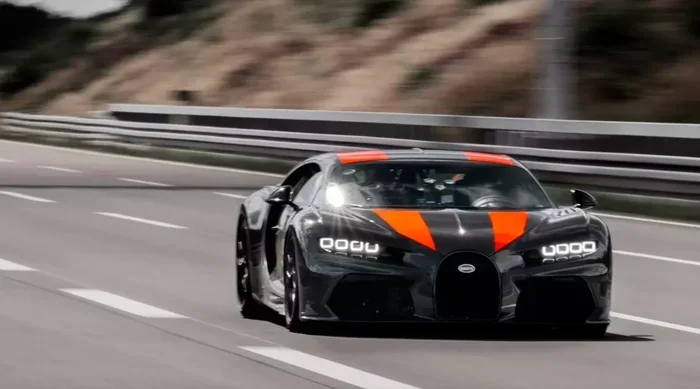
In 2019, Bugatti made history with the Chiron Super Sport 300+. Driver Andy Wallace took the car to a verified top speed of 304.77 mph. This was the first time a production car had broken the 300 mph barrier. The achievement was not a fluke. It was the result of years of engineering and preparation.
The car was modified for the run with longer bodywork, a revised aerodynamic package, and special tires rated for over 300 mph. After the record, Bugatti offered a limited production version of the car to customers. Only 30 were made, and they sold out almost immediately.
The Bolide: Track-Focused Speed Demon
Bugatti did not stop at 300 mph. In 2020, the company unveiled the Bolide, a track-only hypercar designed for maximum performance. The Bolide produces over 1,800 horsepower and weighs less than 2,700 pounds. This power-to-weight ratio makes it one of the most extreme performance machines ever built.
Bugatti claims the Bolide can lap the Nürburgring in under 5 minutes and 20 seconds. If true, this would make it faster than many purpose-built race cars. The Bolide represents the absolute peak of Bugatti’s engineering capabilities and shows where the company sees the future of speed.
The Future of Bugatti Speed
Bugatti is now part of the Bugatti Rimac partnership, which combines French hypercar luxury with Croatian electric vehicle technology. Rumors suggest that future Bugatti models may include hybrid or fully electric powertrains. This could open up new possibilities for speed, as electric motors deliver instant torque without the need for a traditional transmission.
Whether Bugatti continues with combustion engines or embraces electrification, one thing is certain. The company will always chase the next speed record. That is simply in Bugatti’s DNA.
Owning a Bugatti: What It Takes
The Customization Process
Every Bugatti is built to order. Buyers work with Bugatti’s bespoke team to choose colors, materials, and specifications. No two Bugattis are exactly alike. The process is personal and detailed, from the stitching on the seats to the finish on the engine cover.
If you are wondering how long do custom car orders take, the answer is typically several years. Each car takes thousands of hours to build by hand. The waiting is long, but for most owners, the result is worth every month.
Maintenance and Care
Owning a Bugatti comes with responsibilities. These cars require specialized maintenance that only trained technicians can perform. Regular services include engine checks, aerodynamic component inspections, and brake system evaluations. The cost of ownership is high, but Bugatti owners expect nothing less than perfection.
Bugatti also offers a comprehensive ownership experience. This includes access to exclusive events, track days, and concierge services. It is not just about buying a car. It is about joining a community of enthusiasts who share a passion for extreme performance.
Conclusion
Bugatti achieves extreme speed through a combination of brute force and brilliant engineering. The quad-turbo W16 engine delivers over 1,500 horsepower. Advanced aerodynamics keep the car stable at 300 mph. Lightweight carbon fiber construction keeps the weight down. And a sophisticated transmission and drivetrain put all that power on the road exactly where it needs to go.
Every record Bugatti breaks is a testament to years of research, testing, and passion. From the Chiron Super Sport 300+ to the track-focused Bolide, the brand continues to push the limits of what is possible in a production car. The question is not whether Bugatti will break another record. The question is when.
If you love cars and dream about speed, Bugatti is the ultimate example of what is possible when engineering meets ambition. The next time you see a Bugatti fly past, remember everything that went into making that moment possible. It is not just a car. It is a masterpiece of speed.
Frequently Asked Questions
What engine does Bugatti use to achieve extreme speed?
Bugatti uses an 8.0-liter quad-turbo W16 engine that produces over 1,500 horsepower. Four turbochargers work together to eliminate turbo lag and deliver smooth, massive power across the entire rev range. This engine is the heart of Bugatti’s speed records.
How fast can a Bugatti go?
The Bugatti Chiron Super Sport 300+ reached a verified top speed of 304.77 mph in 2019. The track-focused Bolide is even more extreme, with claims of over 310 mph. These speeds make Bugatti the fastest production car brand in the world.
Why is aerodynamics so important for Bugatti’s speed?
Aerodynamics reduces drag and increases downforce, both of which are critical at extreme speeds. Without proper aerodynamic design, a car would be pushed back by air resistance or become unstable at high velocity. Bugatti uses active aerodynamic systems that adjust in real time.
How long does it take to build a Bugatti?
Each Bugatti takes several years to build from start to finish. The process includes extensive customization, hand-assembly, and rigorous testing. If you are curious about how long do custom car orders take in general, expect a multi-year timeline for any bespoke hypercar.
What materials does Bugatti use to keep the car lightweight?
Bugatti uses carbon fiber extensively, including a carbon fiber monocoque chassis that weighs less than 250 pounds. The body panels, wheels, and interior components are also made from lightweight materials. This reduces weight while maintaining the strength needed for extreme speeds.
Are Bugatti cars practical for everyday driving?
Despite their extreme capabilities, modern Bugatti cars are surprisingly usable for daily driving. They feature comfortable interiors, advanced technology, and all-wheel drive for various road conditions. However, they are still hypercars designed first and foremost for performance and speed.
=== CONCLUSION ===
Bugatti achieves extreme speed through an incredible combination of engineering, materials, and technology. The quad-turbo W16 engine, active aerodynamics, lightweight construction, and advanced drivetrain all work together to create the fastest production cars on Earth. Every record broken is a testament to the brand’s commitment to pushing boundaries.
Understanding how Bugatti achieves extreme speed gives us a deeper appreciation for the craftsmanship and innovation behind each vehicle. From the first blueprint to the final test run, every detail is perfected with one goal in mind: going faster than anyone thought possible. Bugatti does not just break records. It redefines what speed means.