A Car Traveling at a Constant Speed of 20m S Explained
A car traveling at a constant speed of 20m/s moves 20 meters every second without speeding up or slowing down. This steady pace equals about 72 km/h or 45 mph, making it a common speed for city driving and highway cruising. Understanding this concept helps drivers, students, and car enthusiasts grasp the basics of motion, distance calculations, and acceleration. In this guide, we break down everything you need to know about constant speed travel in simple, practical terms.
Imagine you are cruising down a straight road. The speedometer reads exactly 20 meters per second. You are not pressing the gas pedal harder. You are not hitting the brakes. The car is moving at a steady, unchanging pace. This is what we call a car traveling at a constant speed of 20m/s. It is one of the simplest yet most important concepts in physics and driving.
Whether you are a student learning about motion, a driver curious about how fast you are really going, or just someone who loves cars, this topic matters. Constant speed affects fuel economy, travel time, and even safety on the road. In this article, we will walk through everything step by step. You will learn what constant speed really means, how to calculate distance and time, and why this speed matters in real life. Let us get started.
Key Takeaways
- Constant speed means no acceleration: A car traveling at a constant speed of 20m/s covers equal distances every second with zero change in velocity.
- 20m/s equals 72 km/h or 45 mph: This is a realistic speed for everyday driving on roads and highways.
- Distance is easy to calculate: Multiply speed by time to find out how far the car travels in any given period.
- Uniform motion involves zero net force: When a car moves at steady speed, all forces acting on it are balanced.
- Real-world examples are everywhere: Cruise control on highways and steady city driving both mimic this type of motion.
- Speed-time graphs stay flat: A horizontal line on a speed graph shows the car is not accelerating.
- Distance-time graphs are straight lines: A constant slope on a distance graph confirms uniform speed.
📑 Table of Contents
What Does It Mean When a Car Travels at 20m/s?
When we say a car traveling at a constant speed of 20m/s, we mean the car covers exactly 20 meters every single second. The number does not change. There is no speeding up. There is no slowing down. This type of motion is called uniform motion or constant velocity in physics.
Speed and velocity are related but different. Speed tells you how fast something moves. Velocity adds direction to that speed. So a car going 20m/s east has a velocity of 20m/s. But if the car turns a corner, its velocity changes even if the speed stays the same. For now, we focus on straight-line motion at a steady rate of travel.
Why 20m/s Is a Meaningful Speed
Twenty meters per second might not sound like much. But let us put it in perspective. 20m/s converts to 72 kilometers per hour or about 45 miles per hour. This is a very common speed for cars on city streets and suburban roads. It is also the kind of speed you see when using cruise control on a highway.
Here are some quick comparisons to help you visualize 20m/s:
- Walking speed is about 1.4m/s. A car at 20m/s is over 14 times faster than a brisk walk.
- A cyclist typically rides at 4 to 6m/s. The car is moving 3 to 5 times faster.
- A highway speed limit of 70 mph equals about 31m/s. So 20m/s is slower than most highway speeds but still very much in the driving range.
This speed is realistic and relatable. It is not too fast and not too slow. That makes it a perfect example for learning about steady speed and uniform motion.
The Role of Acceleration in Constant Speed
Here is a key idea. When a car moves at a constant speed of 20m/s, its acceleration is zero. Acceleration means a change in speed over time. If the speed does not change, there is no acceleration. This is true even if the car is moving very fast.
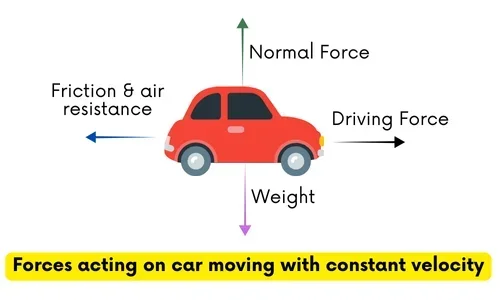
Think of it this way. You are in a car going 20m/s on a straight road. The engine pushes the car forward. Air resistance and friction push back. These forces balance each other out. The result? Zero net force. The car keeps moving at the same speed. No speeding up. No slowing down. This balance of forces is what makes constant speed travel possible.
Many people confuse speed with acceleration. They think a fast car must be accelerating. That is not true. A car can move at a very high speed with zero acceleration. It just has to maintain that speed steadily. Understanding this difference is one of the biggest steps in mastering motion physics.
How Far Does a Car Travel at 20m/s?
One of the most useful things you can do with a constant speed is calculate distance. If you know the speed and the time, you can figure out exactly how far the car goes. The formula is simple and powerful.
The Distance Formula
The basic equation for distance calculation at constant speed is:
Distance = Speed x Time
Or in symbols:
d = v x t
Where d is distance, v is speed, and t is time. If a car is traveling at a constant speed of 20m/s, you simply multiply 20 by the number of seconds. Let us look at some examples.
Practical Distance Examples
Let us walk through a few scenarios. These show how easy it is to calculate distance for a car moving at 20m/s.
Example 1: How far in 10 seconds?
d = 20m/s x 10s = 200 meters. The car travels 200 meters in just 10 seconds. That is about two football fields.
Example 2: How far in one minute?
One minute is 60 seconds. d = 20m/s x 60s = 1,200 meters. That is 1.2 kilometers or about 0.75 miles.
Example 3: How far in one hour?
One hour is 3,600 seconds. d = 20m/s x 3,600s = 72,000 meters. That is 72 kilometers or 45 miles.
These calculations show why 20m/s equals 72 km/h. The math lines up perfectly. This is one of the easiest ways to convert between meters per second and kilometers per hour. Just multiply by 3.6.
Using Distance-Time Graphs
A distance-time graph is a great way to visualize constant speed. On this graph, time goes on the horizontal axis. Distance goes on the vertical axis. When a car travels at a constant speed, the graph is a straight line. The line slopes upward at a steady angle.
The slope of the line equals the speed. A steeper slope means a faster speed. A flatter slope means a slower speed. For a car at 20m/s, the slope is constant. The line rises 20 meters for every 1 second that passes. This straight-line pattern is the visual signature of uniform motion.
If the line curves, that means the speed is changing. The car is accelerating or decelerating. But a straight line tells you the speed is steady. This is a quick and easy way to check whether a car is moving at a constant speed of 20m/s or at some other pace.
Speed-Time Graphs and What They Tell You
Another important tool is the speed-time graph. This graph shows how speed changes over time. For a car traveling at a constant speed, the graph is a flat horizontal line. The line sits at 20m/s on the vertical axis and stretches across the entire time period on the horizontal axis.
The flat line tells you something crucial: the acceleration is zero. There is no slope on the line. No slope means no change in speed. This is the graphical proof that the car is not accelerating.
What If the Line Is Not Flat?
If the line goes up, the car is speeding up. The slope of the line gives you the acceleration value. If the line goes down, the car is slowing down. This is called deceleration or negative acceleration.
But for our topic, the line stays flat. A car traveling at a constant speed of 20m/s produces a perfectly horizontal line on a speed-time graph. This is one of the simplest and clearest graphs in all of physics. It makes the concept of zero acceleration easy to see and understand.
Area Under the Speed-Time Graph
Here is a bonus tip. The area under a speed-time graph gives you the distance traveled. For a flat line at 20m/s, the area is a rectangle. You find the area by multiplying the speed (20m/s) by the time. This gives you the exact same result as the distance formula. It is a nice way to double-check your work and build a deeper understanding of motion physics.
Real-World Examples of a Car at 20m/s
Theory is great. But seeing how this applies in real life makes it stick. Let us look at some everyday situations where a car might travel at 20m/s.
City Driving
In many cities, the speed limit is 50 km/h or 30 mph. But a common speed for cars moving through traffic or on clear roads is closer to 72 km/h. That is exactly 20m/s. When you are driving on a long, straight road with a green light and no traffic, you often settle into this pace.
Many modern cars have cruise control systems. You can set cruise control to maintain a steady speed. If you set it to 72 km/h, the car will hold 20m/s. The engine adjusts automatically to keep the speed constant. This is a real-world example of uniform motion in action.
Highway Cruising
On a highway, cars often travel at steady speeds for long stretches. While highway speeds are usually higher, 20m/s is common in many countries where the speed limit is 70 km/h or lower. Even at higher speeds, the principle remains the same. When the speedometer holds a steady reading, the car is in constant speed travel.
Fuel Economy and Steady Speed
Did you know that driving at a constant speed saves fuel? When a car accelerates and decelerates frequently, the engine works harder. It uses more gas. But when a car maintains a steady speed of 20m/s, the engine operates efficiently. The fuel injection system delivers a consistent amount of fuel. This is why highway driving often gives better mileage than stop-and-go city driving.
Using cruise control at 20m/s on a flat road is one of the best ways to maximize fuel economy. The car does not waste energy on unnecessary acceleration. It just keeps moving at the same rate of travel.
Safety and Steady Speed
Safety is another reason to understand constant speed. When a car moves at a predictable pace, other drivers can anticipate its behavior. A car that speeds up and slows down erratically is harder to predict. A car at uniform motion is easier for other drivers to judge. This is especially important on long road trips and highway merges.
Calculating Time and Speed with Easy Math
The formulas for constant speed are some of the simplest in all of physics. Once you know one of the three variables, you can always find the other two.
Finding Time
If you know the distance and the speed, you can find the time. The formula is:
Time = Distance / Speed
For a car at 20m/s, how long does it take to travel 1,000 meters?
t = 1,000m / 20m/s = 50 seconds. That is less than a minute to cover a full kilometer.
Finding Speed
If you know the distance and the time, you can find the speed. The formula is:
Speed = Distance / Time
Suppose a car covers 600 meters in 30 seconds. What is its speed?
v = 600m / 30s = 20m/s. You just confirmed the car is moving at a constant speed of 20m/s.
These three formulas form the backbone of speed calculation. They work for any constant speed scenario, not just 20m/s. Once you master them, you can solve a wide range of motion problems with confidence.
A Quick Reference Table
Here is a handy comparison table for a car traveling at 20m/s:
| Time | Distance Traveled | Equivalent Speed |
|---|---|---|
| 1 second | 20 meters | 20m/s (72 km/h) |
| 10 seconds | 200 meters | 20m/s (72 km/h) |
| 1 minute | 1,200 meters (1.2 km) | 20m/s (72 km/h) |
| 5 minutes | 6,000 meters (6 km) | 20m/s (72 km/h) |
| 1 hour | 72,000 meters (72 km) | 20m/s (72 km/h) |
This table shows that no matter how long the car travels, the speed stays the same. The distance just keeps growing at a steady rate. That is the beauty of constant speed.
Common Mistakes and Quick Tips
Learning about constant speed is straightforward, but a few common mistakes trip people up. Here are some pitfalls to avoid and tips to keep in mind.
Common Mistakes
- Confusing speed with velocity: Speed has no direction. Velocity does. Always check whether the problem asks for speed or velocity.
- Forgetting to convert units: 20m/s is not the same as 20 km/h. Always convert to the units you need before calculating.
- Assuming constant speed means no forces: Forces are still acting on the car. They are just balanced. Zero acceleration does not mean zero forces.
- Mixing up distance-time and speed-time graphs: A straight line on a distance-time graph means constant speed. A flat line on a speed-time graph also means constant speed. Know which graph you are reading.
Quick Tips for Mastering Constant Speed
- Practice with real numbers: Plug different time values into the distance formula. See how far the car goes at each interval.
- Draw graphs: Sketching a distance-time or speed-time graph helps you visualize the motion.
- Use cruise control as a mental model: Next time you use cruise control, think about the physics behind it. The car is maintaining a constant speed with zero acceleration.
- Check your units: Always write out the units in your calculations. They help you catch errors and confirm your answer makes sense.
Expert Insights on Constant Speed Motion
Physics teachers often emphasize that constant speed problems are the foundation for more complex topics. Once you understand uniform motion, you are ready to tackle acceleration, force, and energy. The simple equation d = v x t opens the door to kinematic equations that describe all types of motion.
Many engineers and designers use constant speed as a baseline when testing vehicles. They measure how a car performs at a steady 20m/s to evaluate fuel efficiency, engine load, and emissions. This real-world application shows why understanding motion physics matters beyond the classroom.
Key Takeaways
- Constant speed means no acceleration: A car traveling at a constant speed of 20m/s covers equal distances every second with zero change in velocity.
- 20m/s equals 72 km/h or 45 mph: This is a realistic speed for everyday driving on roads and highways.
- Distance is easy to calculate: Multiply speed by time to find out how far the car travels in any given period.
- Uniform motion involves zero net force: When a car moves at steady speed, all forces acting on it are balanced.
- Real-world examples are everywhere: Cruise control on highways and steady city driving both mimic this type of motion.
- Speed-time graphs stay flat: A horizontal line on a speed graph shows the car is not accelerating.
- Distance-time graphs are straight lines: A constant slope on a distance graph confirms uniform speed.
Frequently Asked Questions
What is the acceleration of a car traveling at a constant speed of 20m/s?
The acceleration is zero. When a car moves at a constant speed, there is no change in velocity over time. Acceleration measures how quickly speed changes, so a steady speed of 20m/s means no acceleration at all.
How far does a car travel at 20m/s in 5 minutes?
Five minutes is 300 seconds. Multiply 20m/s by 300 seconds and you get 6,000 meters, or 6 kilometers. A car at a constant speed of 20m/s covers 6 km in 5 minutes on a straight road.
Is 20m/s a fast speed for a car?
20m/s is about 72 km/h or 45 mph. This is a moderate speed, typical for suburban roads and city highways. It is not slow, but it is also not a high-speed highway velocity. It is a very common and practical driving speed.
Can a car have constant speed but changing velocity?
Yes, if the car is going around a curve. The speed can stay at 20m/s, but the direction changes. Since velocity includes direction, a change in direction means a change in velocity. This is called centripetal acceleration and it is different from the constant speed we discussed here.
What forces act on a car moving at a constant speed of 20m/s?
Several forces are at work. The engine provides a forward force through the wheels. Air resistance pushes back against the front of the car. Rolling friction from the tires also opposes motion. At constant speed, all these forces balance out, resulting in zero net force and no acceleration.
How does driving at a constant speed save fuel?
When a car maintains a steady speed, the engine does not need to work harder to accelerate or recover speed after braking. Fuel injection stays consistent, and the engine operates at its most efficient range. This is why using cruise control at a constant speed like 20m/s can noticeably improve fuel economy over time.
Conclusion
A car traveling at a constant speed of 20m/s is one of the clearest examples of uniform motion in physics and everyday driving. We have covered a lot of ground in this article. You now understand what constant speed means, how to calculate distance and time, and why this speed matters in real-world driving situations.
The key ideas are simple but powerful. Constant speed means zero acceleration. The distance formula d = v x t lets you predict exactly how far the car goes. Graphs make the concept visual and easy to understand. And real-world applications like cruise control and fuel economy show why this knowledge is practical and valuable.
Whether you are studying for a physics test, trying to improve your fuel efficiency, or just curious about how motion works, understanding a car at 20m/s gives you a strong foundation. Apply these concepts the next time you are on the road. Watch the speedometer. Notice when you are at a steady pace. Think about the forces at play and the distance you cover every second.
Motion physics does not have to be complicated. Start with constant speed. Master the basics. Then build toward more advanced topics like acceleration and force. The journey of a thousand kilometers begins with a single step and a steady speed of 20 meters per second.