How Much Does All 4 Brake Pads Cost and What Affects It
Replacing all 4 brake pads typically costs between $300 and $800 for parts and labor, but the final price depends on your vehicle, pad material, and where you go for service. Ceramic pads cost more upfront but last longer and are quieter, while semi-metallic pads offer better performance for less. Doing the job yourself can cut the cost in half, but it requires basic tools and know-how.
When your mechanic tells you it’s time to replace your brake pads, the first question that pops into your head is usually the same: how much does all 4 brake pads cost? It’s a fair question, because brake service isn’t cheap, and you want to know what you’re getting into before you hand over your keys. The truth is, the total price can swing quite a bit depending on a handful of factors, from the type of pad material to whether you tackle the job yourself or visit a shop.
In this guide, I’ll walk you through the real numbers, break down what drives the price, and give you practical ways to save money without sacrificing safety. I’ll also cover when it’s time to replace all 4 pads at once and how to spot the warning signs before they turn into a bigger problem. By the end, you’ll feel confident making the right decision for your wallet and your car.
Let’s start with the big picture: what you can expect to pay out of pocket for a full set of brake pads on all four corners of your vehicle.
Key Takeaways
- Average total cost: Most drivers pay $300 to $800 for all 4 brake pads, including parts and labor.
- Pad material matters: Ceramic pads are pricier but quieter and longer-lasting; semi-metallic pads are cheaper and great for performance.
- Labor adds up: A shop charges $100 to $200 per axle for brake pad replacement, so doing it yourself saves real money.
- Don’t ignore warning signs: Squealing, grinding, or a spongy pedal means your pads are worn and need immediate attention.
- OEM vs aftermarket: OEM pads cost more but match your car’s specs; aftermarket options offer great quality at a lower price.
- Check other components: If your rotors are warped or your calipers are stuck, you’ll need additional repairs that raise the total bill.
- DIY is doable: If you can change a brake light bulb, you can likely swap brake pads with a few basic tools.
📑 Table of Contents
What’s the Real Cost to Replace All 4 Brake Pads?
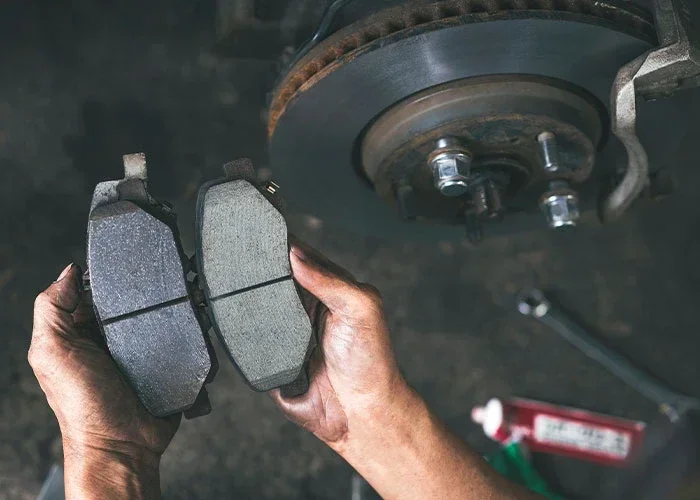
The brake pad replacement cost for all four wheels usually falls between $300 and $800 when you include both parts and labor. On the lower end, you might pay around $150 to $250 for the pads alone if you choose budget-friendly semi-metallic or organic materials and do the work yourself. At the higher end, premium ceramic pads paired with a dealership or specialty shop can push the total past $1,000, especially for luxury or performance vehicles.
Here’s a quick look at what drives that range.
- Parts only (all 4 pads): $50 to $300 depending on material and brand.
- Labor for all 4 corners: $150 to $400 at most independent shops.
- Total with parts and labor: $200 to $800+ for the average sedan or SUV.
If you’re wondering whether you need to change all 4 brake pads at once, the answer is almost always yes. Even if only the front pads are worn, replacing all four ensures balanced braking and prevents uneven wear on your rotors. I’ll explain why in a moment, but first let’s look at what actually makes the price go up or down.
Why the Numbers Vary So Much
Several things influence the final bill. Your vehicle’s make and model is a big one. A compact car like a Honda Civic or Toyota Corolla uses smaller, less expensive pads than a heavy-duty truck or a performance SUV. The type of pad material you choose also plays a huge role. Ceramic pads, which are popular for daily driving, tend to cost more than semi-metallic or organic options. And then there’s the labor rate, which varies widely by region and shop type. A dealership will charge more than a local mechanic, but they often include a warranty on the work.
What Affects the Price of Brake Pads?
Understanding the factors that drive the all 4 brake pads cost helps you make smarter choices. Let’s break down the biggest ones so you know exactly what you’re paying for.
Brake Pad Material
The material your pads are made from is the single biggest cost driver. There are three main types you’ll encounter at any shop.
- Organic pads: Made from rubber, glass, and resin. They’re the cheapest option, usually $30 to $60 for a set of four, but they wear out faster and produce more dust.
- Semi-metallic pads: Contain metal fibers like copper or steel. They offer great performance and last longer than organic pads, costing about $50 to $100 for a full set.
- Ceramic pads: Made from ceramic fibers and copper. They’re the most expensive, often $80 to $150 for a set, but they’re quieter, produce less dust, and can last up to 70,000 miles.
If you’re looking for the best balance of cost and longevity, semi-metallic pads are a solid choice for most drivers. Ceramic pads are worth the extra money if you want a quieter ride and don’t mind spending a bit more upfront.
OEM vs Aftermarket Parts
OEM stands for Original Equipment Manufacturer, meaning the pads are made by the same company that supplied your car’s factory parts. Aftermarket pads are made by third-party companies. OEM pads often cost 20 to 40 percent more than aftermarket equivalents, but they’re guaranteed to match your vehicle’s specifications. Aftermarket brands like Bosch, Akebono, or Power Stop offer excellent quality at a lower price. Unless you drive a high-performance or luxury car where exact tolerances matter, aftermarket pads are a smart way to save money.
Labor Rates and Shop Type
Labor is the other half of the equation. Most shops charge between $100 and $200 per axle for brake pad replacement. That means replacing pads on the front axle alone might cost $100 to $200 in labor, and doing all four corners could double that. Dealerships typically have the highest labor rates, sometimes $150 to $250 per hour, while independent mechanics and chain shops like Midas or Meineke often charge less. If you’re comfortable getting your hands dirty, you can eliminate labor costs entirely and just pay for the parts.
Front vs Rear Brake Pad Costs
Not all four brake pads wear at the same rate. In most front-wheel-drive cars, the front pads do the heavy lifting and wear out two to three times faster than the rear pads. That means you might replace the front pads every 30,000 to 50,000 miles while the rears last 60,000 to 100,000 miles. But when you do replace all four at once, the cost difference between front and rear pads is usually small.
Here’s a simple comparison of what you might pay for each axle.
| Axle | Typical Pad Cost (Parts Only) | Labor Cost | Total (Parts + Labor) |
|---|---|---|---|
| Front Axle | $40 – $120 | $80 – $150 | $120 – $270 |
| Rear Axle | $30 – $100 | $80 – $150 | $110 – $250 |
| All 4 Axles | $70 – $220 | $160 – $300 | $230 – $520 |
As you can see, the front axle often costs a bit more because the pads are larger and the calipers work harder. But the total for all four wheels usually stays within the range we mentioned earlier. Keep in mind that these are average numbers for a standard sedan; trucks and SUVs can cost more.
DIY vs Professional Replacement: Which Saves More?
One of the best ways to slash the brake pad replacement cost is to do the job yourself. If you’ve ever replaced a brake light bulb or swapped out a air filter, you already have many of the skills needed. All you need is a jack, jack stands, a lug wrench, a C-clamp or brake piston tool, and a set of wrenches. The entire process takes about one to two hours for all four corners, and you can save $150 to $300 in labor alone.
Here’s a quick list of what you’ll need to get started.
- A floor jack and jack stands (never rely on a jack alone).
- A lug wrench to remove the wheels.
- A C-clamp or brake piston retraction tool to push the caliper piston back in.
- A set of metric or standard wrenches to remove the caliper bolts.
- New brake pads and, if needed, a thin layer of brake grease for the contact points.
Before you start, I recommend watching a few tutorial videos for your specific vehicle model. Every car is a little different, and you want to make sure you don’t damage the caliper or the brake line. If you’re not comfortable with the idea of working under your car, it’s perfectly fine to let a professional handle it. Your safety matters more than the savings.
Can I Replace a Brake Light Bulb Myself?
Absolutely. In fact, swapping a brake light bulb is one of the easiest DIY jobs you can do. It usually takes about five minutes and costs just a few dollars for the bulb. If you can do that, you’re more than capable of changing your own brake pads. Learn how to replace a brake light bulb yourself and you’ll gain confidence for bigger brake projects.
How to Save Money on Brake Pad Replacement
Saving money on your brake job doesn’t mean cutting corners on safety. Here are a few proven strategies to keep the all 4 brake pads cost as low as possible.
- Buy your own pads: Ordering pads online from Amazon, RockAuto, or AutoZone often saves 20 to 30 percent compared to buying them from the shop. You can then bring them to your mechanic and ask them to install just the parts.
- Shop around for labor rates: Get quotes from at least two or three shops. Independent mechanics are usually cheaper than dealerships, but some specialty brake shops offer competitive rates and expert installation.
- Look for coupons and promotions: Many chain auto parts stores and shops run seasonal brake specials. You might find a discount on pads or a reduced labor rate during slow months like January or August.
- Check your warranty: Some newer vehicles come with a brake pad warranty that covers replacement for the first 36,000 miles. If your car is still under warranty, you might not need to pay anything out of pocket.
- Consider aftermarket pads: High-quality aftermarket pads from trusted brands perform just as well as OEM pads and cost significantly less. Read reviews and ask your mechanic for recommendations.
Quick Tip: Don’t Forget the Hardware
When you buy new brake pads, they usually come with new hardware like clips, shims, and anti-rattle springs. These small parts are cheap but essential for a quiet, smooth brake job. If your shop tries to upsell you on expensive hardware, it’s usually not necessary. Stick with the kit that comes with the pads.
When to Replace Your Brake Pads (and Not a Moment Later)
Ignoring worn brake pads is dangerous and can lead to much more expensive repairs. When the friction material wears down to the metal backing plate, you risk damaging your brake rotors, which are far more costly to replace. Here are the warning signs that your pads need immediate attention.
- Squealing or squeaking noises: A high-pitched sound when you press the brake pedal usually means the pad wear indicator is making contact with the rotor.
- Grinding or growling: This is a serious sign that the pad material is completely gone and metal is grinding against metal. Stop driving and get your brakes checked right away.
- Increased stopping distance: If your car takes longer to stop than it used to, your pads may be too thin to generate enough friction.
- Vibration or pulsation: A shaking feeling through the brake pedal often indicates warped rotors caused by prolonged use of worn pads.
- Brake pad warning light: Some modern vehicles have a dashboard light that illuminates when the pads are low. Don’t ignore it.
Most brake pads last between 25,000 and 65,000 miles, but your driving habits play a big role. If you do a lot of city driving with frequent stops, your pads will wear faster than someone who spends most of their time on the highway. Towing heavy loads or driving in hilly terrain also shortens pad life. If you’re unsure how your pads are doing, ask your mechanic to check the thickness during every oil change. A quick inspection takes just a few minutes and can save you from a costly repair later.
Common Mistakes to Avoid
When it comes to brake pad replacement, a few common mistakes can cost you money and compromise your safety. First, never replace only the worn side. If your front left pad is shot but the front right is still good, replacing just one side leads to uneven braking and pulling to one side. Always replace pads in pairs on the same axle. Second, don’t forget to check your rotors. If the rotors are warped or have deep grooves, new pads won’t seat properly and you’ll still experience vibration. In many cases, resurfacing or replacing the rotors is necessary for a proper job. Third, avoid cheap pads from unknown brands. They might save you $20 upfront, but they often wear out twice as fast and can be noisy. Stick with reputable brands that have solid reviews.
Expert Insight: The Real Cost of Delayed Replacement
Putting off a brake pad replacement might seem like a way to save money now, but it almost always costs more in the long run. Worn pads grind into the rotors, causing uneven scoring that requires rotor resurfacing or full replacement. A new set of rotors can add $200 to $400 to the bill on just one axle. What starts as a $300 brake pad job can quickly become a $600 to $800 rotor and pad replacement. Staying on top of your brake pad lifespan is the smartest thing you can do for both your safety and your wallet.
Conclusion
So, how much does all 4 brake pads cost? For most drivers, the answer is somewhere between $300 and $800 when you include parts and labor. The exact number depends on your vehicle, the pad material you choose, and whether you handle the work yourself or visit a shop. Ceramic pads offer the best comfort and longevity but come with a higher price tag, while semi-metallic pads strike a great balance between performance and cost. No matter which route you choose, never delay a brake pad replacement. Your brakes are the most important safety system in your car, and keeping them in top shape is one of the best investments you can make.
If you’re ready to tackle the job, grab your tools and save some money. If you’d rather leave it to the professionals, use the tips in this article to get a fair price and avoid unnecessary upsells. Either way, you now have the knowledge to make a confident decision and keep your car stopping safely for miles to come.
Frequently Asked Questions
Is it OK to replace only 2 brake pads instead of all 4?
You can replace just one axle if the pads on that side are worn and the others still have plenty of life. However, replacing all 4 brake pads at once is recommended for balanced braking and to prevent uneven rotor wear. If you only replace two, make sure they’re the same brand, material, and thickness as the existing pads on the other side.
How often should I replace my brake pads?
Most brake pads last between 25,000 and 65,000 miles, but driving habits and conditions play a big role. City driving with lots of stops wears pads faster than highway driving. Listen for squealing or grinding noises and have your pads checked regularly. If you’re unsure, a quick inspection during an oil change can tell you exactly how much life is left.
Can I drive with worn brake pads?
You should not drive with worn brake pads. Once the friction material is down to the metal backing plate, you risk damaging the rotors and losing braking power. Worn pads increase your stopping distance and can cause dangerous situations, especially in wet or emergency conditions. Replace them as soon as you notice warning signs.
Does car insurance cover non-accident repairs like brake pad replacement?
Most standard car insurance policies do not cover routine maintenance such as brake pad replacement. These are considered wear-and-tear items that fall under your responsibility. However, if a brake failure causes an accident, your collision coverage may help pay for the resulting repairs. Always check your specific policy for details on what’s covered.
What’s the difference between ceramic and semi-metallic brake pads?
Ceramic pads are made from ceramic fibers and copper. They’re quieter, produce less dust, and last longer, but they cost more upfront. Semi-metallic pads contain metal fibers and offer excellent performance and durability at a lower price. They’re a great choice for most daily drivers who want a balance of cost and effectiveness. Organic pads are the cheapest option but wear out faster and are less performant.
Can I save money by buying brake pads online?
Yes, buying brake pads online from retailers like Amazon or RockAuto often saves 20 to 30 percent compared to purchasing them from a repair shop. You can bring your own parts to a mechanic and pay only for the labor. Just make sure you order the correct pads for your specific vehicle model and year to avoid compatibility issues.